The Invisible Engineering Behind Reliable AI Agents
AI models are non-deterministic, but enterprise production systems demand absolute reliability. While durable orchestrators (such as Temporal or LangGraph) persist workflow checkpoints and transactional databases prevent concurrent write collisions, the AI Agent Control Plane provides the critical runtime governance layer—halting runaway loops, blocking unauthorized tool executions before dispatch, enforcing pre-call spend caps, and capturing full OpenTelemetry observability around every step the model takes.
Key takeaways
- •Reliability is an architectural challenge, not prompt engineering. Autonomous agents fail due to network timeouts, unhandled tool errors, concurrent state races, and infinite loops—none of which are solved by model prompts alone. Reliable systems place deterministic control planes around non-deterministic models.
- •Durable state and operation-scoped idempotency make retries safe. Persist a single deterministic key per logical operation and reuse it across retries and restarts. Downstream services enforce deduplication within their retention windows, while background reconcilers heal two-phase crashes.
- •Pre-execution policies enforce runtime safety before tool execution. Runtime control planes intercept high-risk tool arguments, spend spikes, and sensitive data leakage before external systems are contacted, while interactive human approvals safeguard high-stakes business mutations.
- •Clarify system ownership across the stack. Orchestrators provide execution durability across crashes; databases and downstream APIs prevent write conflicts and deduplicate mutations; Traccia enforces pre-execution runtime policies and provides distributed observability. Blurring these roles creates systemic reliability gaps.
Engineering Pillars at a Glance
Summary of critical reliability challenges in production agent architectures, typical failure modes, required architectural patterns, and where Traccia provides runtime governance.
| Engineering Pillar | Production Failure Mode | Architectural Pattern | How Traccia Enables It |
|---|---|---|---|
| State Management | Process crash loses progress, restarting entire multi-step workflow | Persistent checkpointing, durable event logs (Temporal / LangGraph) | Correlates checkpoint tokens with trace context across runs to diagnose state drift and redundant steps (prevention is enforced by orchestrator state replay) |
| Retry Management | Network timeout leads to blind retry and duplicate refunds or charges | Operation-scoped idempotency keys, downstream deduplication stores, backoff with jitter | Runtime telemetry surfaces retry counts, jitter intervals, and deduplication badges while policy guards prevent runaway retry storms (deduplication is enforced downstream) |
| Concurrency Control | Multiple subagents overwrite shared database rows simultaneously (lost updates) | Database optimistic concurrency control (OCC), version tagging, lease locking | Maps multi-agent handoff trees, traces distributed contention, and alerts on serial bottlenecks across subagents |
| End-to-End Tracing | High-level summaries hide failed tool calls, latency bottlenecks, and silent errors | OpenTelemetry GenAI semantic conventions, distributed context propagation | OpenTelemetry GenAI waterfall unifying session spans, model tokens, latencies, and provider-attributed micro-cost estimates |
| Security & Policy Enforcement | Prompt injection triggers unauthorized tool calls or sensitive data leakage | Pre-execution policy interceptors, tool argument sandboxing, human approvals | Pre-execution @govern policy interceptor, telemetry PII redaction, and policy approval gating for high-stakes tool calls |
| Cost Governance | Infinite reasoning loops and runaway prompts burn API budgets overnight | Pre-call token circuit breakers, per-session budget limits, model fallbacks | Pre-call Spend Cap with Cheaper Model reshaping, Loop Cap circuit breakers, and live FinOps attribution |
Why AI Agent Reliability Breaks in Production
AI agents are becoming increasingly capable. They can analyze information, call external APIs, query databases, execute code, delegate tasks to other agents, and complete workflows with minimal human intervention.
A developer can build a basic AI agent with an LLM, a few tools, and a well-written system prompt. Within a few hours, it might successfully complete a customer support request, generate a report, or retrieve information from multiple sources.
But what happens when that agent enters production?
An API stops responding halfway through a workflow. Two agents attempt to update the same customer record. A tool executes successfully, but the agent never receives its response. A retry issues a duplicate refund payout. An agent enters an infinite reasoning loop and consumes more tokens than expected.
Suddenly, the problem is no longer about how intelligently the model responds.
It is about how reliably the entire system behaves.
A reliable AI agent is not simply an intelligent model connected to tools. It is an engineered system designed to handle uncertainty, recover from failures, maintain state, enforce boundaries, and make every action observable.
And most of that engineering happens behind the scenes.
To build dependable autonomous systems, engineering teams must maintain strict boundaries between three distinct architectural layers:
- Durable Orchestrators (Temporal, LangGraph): Responsible for execution durability—persisting workflow event histories, serializing graph step checkpoints across container restarts, and orchestrating deterministic step replays.
- Databases and Downstream APIs (PostgreSQL, Stripe, Internal CRM): Responsible for write conflict prevention and deduplication—enforcing ACID transactions, row-level optimistic concurrency control (OCC), and durable server-side deduplication tables within provider retention windows.
- Runtime Policy Control Plane (Traccia): Responsible for pre-execution policy enforcement and end-to-end observability—evaluating spend caps, tool argument constraints, loop breakers, and redacting sensitive PII in exported telemetry spans before data enters observability storage, while correlating distributed OpenTelemetry traces across agent steps.
Agents Need More Than Intelligence
Traditional software generally follows predefined instructions. Given the same input and conditions, a deterministic program is expected to follow the same execution path.
AI agents work differently.
An agent decides what to do next based on the available context, previous results, model responses, and tool outputs. The execution path can change from one run to another.
Consider a customer support refund workflow:
Figure 1. Architecture of a multi-step autonomous refund workflow: Because execution touches customer databases, subagent handoffs, external payment APIs, and CRM systems, unhandled failure at any single step leaves the system in an inconsistent state without durable engineering.
Every step introduces a potential failure point.
The database might be unavailable. The payment API might time out. The verification agent might return incomplete information. The model might choose an incorrect tool.
Even if six steps succeed, one failure can leave the entire workflow in an inconsistent state.
This is why reliability must be designed into the complete agent architecture, rather than depending entirely on the LLM.
Just as API Gateways manage microservice traffic and IAM controls user permissions, an AI Agent Control Plane like Traccia governs the runtime execution of autonomous models. Workflow durability is maintained by orchestrators persisting checkpoints, and write collisions are prevented by transactional databases; Traccia provides the complementary runtime policy layer—evaluating pre-execution policies, halting runaway tool loops, blocking unauthorized payloads before dispatch, and delivering end-to-end trace observability across every step the model takes.
Never Let an Agent Lose Its Progress
One of the most important engineering challenges in autonomous agents is maintaining execution state.
An agent does not simply generate an answer and finish. It may execute dozens of operations, interact with external services, and depend on information collected several minutes earlier.
What happens if the application crashes halfway through?
Without persistent state, the agent might lose its progress and restart the entire workflow. This causes:
- Repeated API calls to third-party services.
- Duplicate database operations.
- Lost intermediate results.
- Unnecessary LLM calls and token consumption.
- Inconsistent workflow execution.
Checkpointing and Durable Execution
Checkpointing allows an application to save its execution state at important stages. Instead of remembering only the final response, the system maintains information about completed steps, intermediate outputs, pending operations, and workflow progress.
Illustrative workflow: successful earlier steps do not need to be repeated when recovery is supported.
Frameworks such as LangGraph persistence provide checkpointing mechanisms for saving graph state and resuming interrupted workflows. Temporal provides durable execution through workflow history and deterministic event replay.
However, checkpointing alone is not enough. While the orchestrator durably records internal execution progress, external side effects must also be designed to handle retries and distributed failures safely.
The Key Principle
Traccia correlates state checkpoint tokens with OpenTelemetry trace context across multi-step agent runs. When an interrupted workflow resumes, Traccia surfaces whether previously recorded tool spans are being re-executed, diagnosing redundant reasoning or state drift across ephemeral agent containers while durable orchestrator checkpoints ensure execution is safely skipped.
When a Failed Request Is Not a Failed Operation
Retries are a fundamental part of distributed systems. When an agent calls an external API, it may encounter network timeouts, HTTP 429 rate limits, temporary server errors, database connection failures, or model provider outages.
A common approach is to retry the failed operation.
But there is a dangerous hidden problem.
Imagine an autonomous customer support agent issuing a $150 customer refund. The payment provider processes the refund transaction successfully, but the HTTP response never reaches the agent due to a dropped socket or network timeout.
The agent assumes the request failed and blindly retries it. If the endpoint is not properly deduplicated, the payment provider processes a second refund. The customer receives $300 instead of $150, the merchant suffers a direct financial loss, and accounting books fall out of balance.
What an Unsafe Retry Looks Like
1. Agent dispatches $150 refund request
2. Payment provider processes refund successfully
3. Response times out (Network connection dropped)
4. Agent assumes failure
5. Agent retries request → Duplicate refund issued ($300 total refunded)!
Idempotency Keys: Agreement Headers vs. Durable Enforcement
An idempotent operation produces the same intended effect even if the same request is executed multiple times.
A crucial architectural principle is often misunderstood: idempotency keys do not themselves guarantee duplicate-free effects.
An idempotency key sent by a client (e.g., via the Idempotency-Key HTTP header) is merely an intent token. The receiving service must durably enforce deduplication. To do so, the receiving API must maintain an atomic, persistent deduplication datastore that records the incoming key, verifies whether the operation is currently in-flight or completed, and returns the original cached response.
Persisting One Key Per Logical Operation (The Re-Generation Trap)
A critical implementation rule is that an idempotency key must identify the logical business operation, not the physical network attempt:
# FLAWED: Generating a new UUID on each retry defeats deduplication entirely!# If this retries or restarts after a crash, a new key triggers a duplicate refund:attempt_id = str(uuid.uuid4())[:8]flawed_key = f"ref_op_48291_{attempt_id}"  # DANGEROUS: defeats deduplication
# RECOMMENDED: Persist one deterministic key per logical refund operation# and REUSE it across all retries, reconnects, and process restarts:logical_operation_id = "refund_48291_item_headphones_part1"
# 1. Look up or record the logical operation in durable storage (ledger / state machine)ledger_entry = operation_ledger.get_or_create(    operation_id=logical_operation_id,    defaults={        "order_id": 48291,        "amount": 150.0,        "idempotency_key": f"idemp_{logical_operation_id}",  # Persisted ONCE        "status": "DISPATCHING"    })
# 2. Always reuse the persisted key on initial dispatch AND every retry:payment_gateway.refund(    order_id=ledger_entry.order_id,    amount=ledger_entry.amount,    idempotency_key=ledger_entry.idempotency_key  # Reused across retries & restarts!)
If an agent generates a fresh UUID inside a retry loop, it defeats the idempotency contract because the server views every retry attempt as a brand-new request. The key must be written to durable storage before calling the external API, and that exact same persisted key must be passed on attempt 1, attempt 2, and attempt N after a crash recovery.
This also resolves the entity-scope trap. In real-world e-commerce, an order frequently undergoes multiple partial refunds—such as a $30 refund for damaged shipping today, and a $50 refund for a defective accessory next week. If an agent reuses an order-level key like refund-order-48291 for both partial refunds, the payment gateway will look up the key from the first refund, treat the second refund as a duplicate, and return the cached $30 response (dropping the $50 refund) or fail with an idempotency mismatch error. Binding one deterministic key per logical refund operation (e.g. idemp_refund_48291_item_headphones_part1) supports multiple partial refunds without collision.
Retention Windows and Conflict Semantics (Stripe and AWS)
Deduplication guarantees are time-bounded by the receiving service. For example, in Stripe's idempotency contract , keys and cached responses are retained for at least 24 hours in API v1 (and 30 days in API v2). After the retention window expires, a retried request with that key is treated as a brand-new operation rather than a replay.
If an orchestrator or background reconciler restarts after the gateway's retention window has lapsed (e.g. 24 hours later in Stripe API v1), blindly resending with the expired key risks duplicate refunds. However, naively performing a read check and then generating a new key introduces a catastrophic distributed race condition: if two recovery workers run concurrently, both can query the read API, both see "no refund found," generate separate recovery keys, and dispatch duplicate mutations.
To eliminate this race, recovery reconciliation must enforce four strict distributed invariants:
- 1. Atomic Operation Ownership: A recovery worker must acquire exclusive, atomic ownership of the operation record in the durable ledger (e.g. via
SELECT ... FOR UPDATE SKIP LOCKEDor an exclusive conditional lease with heartbeat expiration) before performing any read queries or mutation dispatches. - 2. Reconcile by Logical Operation Identity: Workers must query downstream APIs using the immutable business entity and operation identity (e.g.
order_idand logicaloperation_id) rather than ad-hoc keys, verifying whether an earlier attempt settled. - 3. Persist One Shared Recovery Key: If the read API confirms no settlement occurred, the worker must generate and persist exactly one deterministic recovery key directly into the shared ledger entry within the atomic transaction. All failovers, retries, and secondary recovery workers must read and reuse that single persisted key, ensuring downstream deduplication remains intact.
- 4. Escalate Ambiguous Results: If the downstream read API returns an ambiguous status (e.g., HTTP 500/504 timeout, connection drop during read, or rate limit), workers must never generate a new key or re-dispatch blindly. The workflow must suspend, preserve the unconfirmed ledger state, and escalate to an application dead-letter queue for operator remediation.
Receiving services also define distinct error semantics for concurrent races versus parameter tampering:
- Concurrent In-Flight Requests (HTTP 409 Conflict): If a retry arrives while an earlier request with the identical key is still actively processing in flight, Stripe returns
HTTP 409 Conflict(with error codeidempotency_key_in_use). Clients must catch the 409, back off, and wait for the in-flight request to complete rather than spawning concurrent calls. - Parameter Mismatches (HTTP 400 Bad Request): If a client reuses an existing idempotency key with different payload parameters (e.g. attempting to refund $150 when the key was originally submitted for $30), Stripe rejects the call with
HTTP 400 Bad Request(parameter mismatch).
The AWS Builders' Library guide on idempotent APIs recommends this same pattern: servers must enforce TTL retention boundaries, reject conflicting payloads with client error codes, and serialize or reject concurrent requests sharing the same token.
The Hardest Distributed Failure: Resolving the Dual-Write Dilemma
The hardest failure in autonomous systems occurs across disparate service boundaries:
Step 6 succeeds (payment gateway settles the $150 refund), but Step 7 fails (internal CRM order status update times out or crashes).
A widespread misconception is that combining checkpointing, idempotency keys, and optimistic concurrency control solves this. They do not collectively create an atomic distributed transaction across both systems.
You cannot execute a distributed ACID rollback across a third-party REST API (Stripe) and an internal CRM database. If the CRM update fails after money has moved, a database transaction rollback cannot claw back the refund from the customer's bank.
Before making the network call, the orchestrator commits an intent record to a local transactional ledger with a unique operation ID (ref_op_ord48291_a1), order ID, amount ($150.00), and a persisted idempotency key (idemp_ref_48291_a1).
The agent dispatches the refund request to the payment gateway using the persisted key.
What if the gateway settles the payment, but the agent container crashes before saving the response to the ledger? The ledger remains at DISPATCHING_PAYMENT. When restarted, the background reconciler sees the unconfirmed dispatch. Because the idempotency key was persisted in Stage 1, the reconciler re-queries the gateway with that exact same key. Within the provider's retention window (e.g. 24 hours for Stripe), the gateway returns the existing settled transaction (re_3O9x7k) without re-executing. The reconciler updates the ledger to PAYMENT_SETTLED. If recovery occurs after the retention window has lapsed, replaying an expired key can trigger a duplicate refund; see the expired-key atomic reconciliation guidance below.
The gateway returns a definitive status. If status: 'succeeded', the ledger records PAYMENT_SETTLED with transaction ID re_3O9x7k. If the payment method requires clearing time (e.g. ACH/SEPA), the ledger enters PAYMENT_PENDING and awaits asynchronous webhooks. If the refund is permanently declined (e.g. chargeback already filed or card closed), the ledger transitions to PAYMENT_FAILED and halts further mutation, avoiding redundant retries.
The agent attempts to mutate the CRM, but the connection drops. Because money has settled, rolling back is impossible. The operation record safely remains in the local ledger as PAYMENT_SETTLED with crm_synced = false.
An out-of-band background worker continuously queries for records in PAYMENT_SETTLED where crm_synced = false older than 60 seconds. To retry safely without duplicate customer notifications or write collisions, the reconciler executes a conditional update (UPDATE orders SET status = 'REFUNDED', refund_id = :id WHERE id = :order_id AND status != 'REFUNDED') and passes a CRM-level idempotency key (Idempotency-Key: crm_sync_48291_a1). Once confirmed, the ledger advances to COMPLETED.
If the CRM permanently rejects the update (e.g., schema constraint violation or deleted customer ID), the reconciler stops retrying, marks the record as REQUIRES_OPERATOR_REVIEW, and pushes an incident to your application dead-letter queue (e.g. PagerDuty, Jira, or internal admin dashboard) for manual operator remediation.
Delineating Ownership: Telemetry Diagnostics vs. Enforcement Invariants
To design reliable systems, teams must maintain clear ownership boundaries across components:
- Downstream APIs and Relational Databases: Enforce durable deduplication stores, retention windows (e.g. Stripe's 24 hours in v1, 30 days in v2), and ACID transaction invariants.
- Workflow Orchestrators (Temporal / LangGraph): Enforce state machine checkpoint serialization, deterministic graph transitions, and process recovery.
- Traccia Runtime Control Plane: Enforces pre-execution policy boundaries (
@govern, Spend Caps, Loop Breakers, telemetry PII redaction) and provides OpenTelemetry observability.
Core Distinction
Coordinating Shared State Across Agents
As organizations move from single-agent applications to multi-agent systems, another engineering problem becomes critical: concurrency.
Consider an e-commerce application where two autonomous agents operate on the same order simultaneously:
- Agent A checks order #48291 and decides that the order should be cancelled.
- Agent B checks the same order and begins processing a partial refund.
- Both agents read the original order status at version 3.
- Both spend several seconds reasoning and executing their respective workflows.
- Both attempt to write back to the order record.
Without proper coordination, one agent will overwrite the other's update. This is known as a lost update.
Database-Level Concurrency Coordination
Several established database patterns coordinate concurrent agent access:
| Technique | Enforcement Layer | Purpose |
|---|---|---|
| Optimistic Concurrency Control (OCC) | Relational Database | Detects whether a record changed after read using version numbers |
| Pessimistic Row Locking | Relational Database | Blocks competing updates via SELECT ... FOR UPDATE during transactions |
| Distributed Locks / Leases | Redis / DynamoDB | Provides time-bounded exclusive ownership of a shared resource across agents |
| Unique Constraints | Relational Database | Guarantees no duplicate records or duplicate operations can be written |
For example, optimistic locking uses a version column:
UPDATE orders SET status = 'CANCELLED', version = version + 1 WHERE order_id = 48291 AND version = 3;If another agent has updated the order in the interim, the version will have incremented to 4, causing the query to affect 0 rows. The application detects the conflict, reloads the fresh state, and re-evaluates its reasoning path.
LLM reasoning does not provide transaction isolation. Concurrency coordination must be enforced by the underlying database and coordination infrastructure.
When orchestrators delegate sub-tasks to parallel agents, Traccia traces the entire multi-agent handoff tree. Traccia tracks resource contention and lock hold durations across concurrent agent sessions, alerting developers whenever multiple agents collide on the same entity or enter competing mutation loops.
End-to-End Tracing with OpenTelemetry
Imagine an AI agent takes 25 seconds to complete a customer request. The final response is correct, but the execution was slow and costly.
What actually happened during those 25 seconds?
- Did the LLM take 15 seconds to generate reasoning tokens?
- Did a downstream database query stall for 8 seconds?
- Did the agent thrash tools in an unneeded retry loop?
- Did a subagent handoff drop its context payload?
Conventional application logs tell you only that the request returned HTTP 200. They fail to reveal the hierarchical execution waterfall.
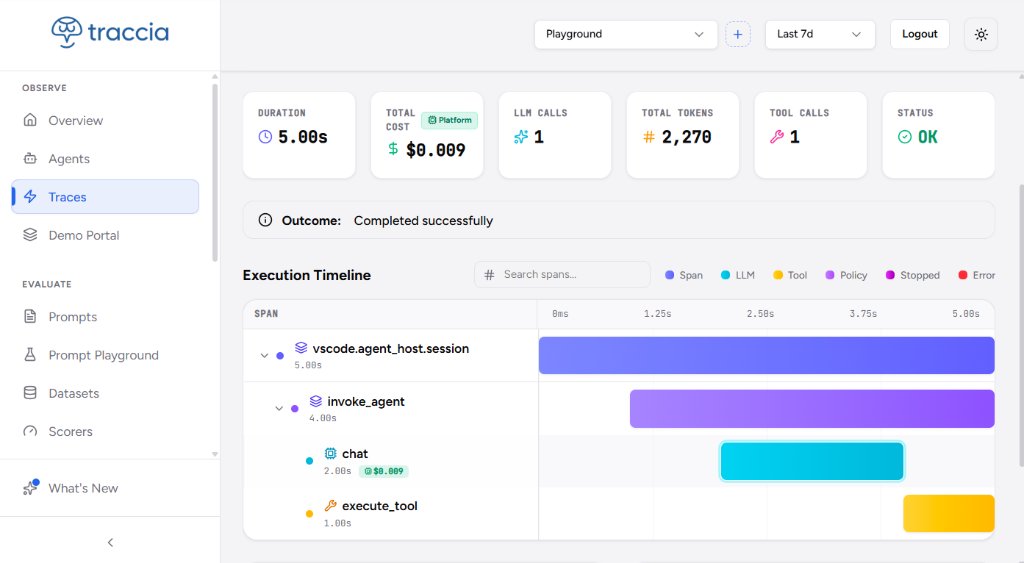
Figure 2. Real trace execution waterfall in Traccia showing the root session span (vscode.agent_host.session), orchestrator invocation (invoke_agent), LLM chat inference with token breakdown and estimated SDK cost (chat, $0.009, 2,270 tokens), and downstream tool execution (execute_tool).
Cost and Tracing Nuances: Qualifying Telemetry Claims
Claims of "exact dollar cost" and "complete execution visibility" must be grounded in the operational nuances of GenAI telemetry:
- Pricing Estimates vs. Billed Actuals: Trace-level LLM costs are SDK calculations derived from provider list price tables and token counts reported in response metadata. Invoices may differ based on enterprise committed-use discounts, tier pricing, and rounding rules.
- Prompt Caching Discounts: Modern models (e.g. Anthropic Prompt Caching, OpenAI cached inputs) discount cached input tokens by 50% to 90%. Traccia ingests cache read metrics to accurately attribute net model costs.
- Trace Sampling in High-Throughput Systems: High-volume enterprise architectures cannot store 100% of telemetry spans without excessive cost. Teams employ head- or tail-sampling (e.g. retaining 100% of error or high-latency traces, and 5% of normal executions).
- Asynchronous Context Propagation: Multi-agent systems communicating across message queues (Kafka, SQS) require explicit W3C
traceparentheader propagation to stitch asynchronous agent tasks back into unified execution trees.
Full native support for the active OpenTelemetry GenAI semantic conventions (gen_ai.provider.name, gen_ai.operation.name, gen_ai.request.model, updating from deprecated gen_ai.system). Ingest from LangGraph, CrewAI, AutoGen, and custom Python/Node agents with zero vendor lock-in.
Trace multi-agent delegation trees, tool calls, and model reasoning in a unified hierarchical waterfall. Inspect tool inputs, outputs, error stacks, and token latencies in milliseconds.
Live SDK pricing engine computes estimated token costs upon ingest using updated provider list prices (OpenAI, Anthropic, Gemini), incorporating prompt cache discounts.
Automatically identifies failed tool spans, HTTP timeouts, runaway retries, and high-latency bottlenecks with 1-click root cause attribution.
Security Boundaries for Autonomous Systems
Unlike standard applications with fixed API endpoints, autonomous agents dynamically generate tool arguments and execute actions based on model outputs. This exposes critical attack vectors:
- Prompt Injection: Untrusted external text tricks the agent into invoking unauthorized tools or exfiltrating sensitive records.
- Privilege Escalation: An agent calls internal APIs with parameters exceeding the calling user's authorization.
- Data Leakage: Sensitive customer data (PII, credit card numbers, auth tokens) is passed into external third-party LLM prompts.
Pre-Execution Policies vs. Post-Execution Logs
Most security logging tools only discover policy violations after the call has already executed. In production, security boundaries must be enforced pre-execution.
How Traccia Enforces Tool Boundaries
policy_fail_mode="closed" in init() for strict fail-closed enforcement on financial mutations, or policy_fail_mode="open" for permissive operation during network outages.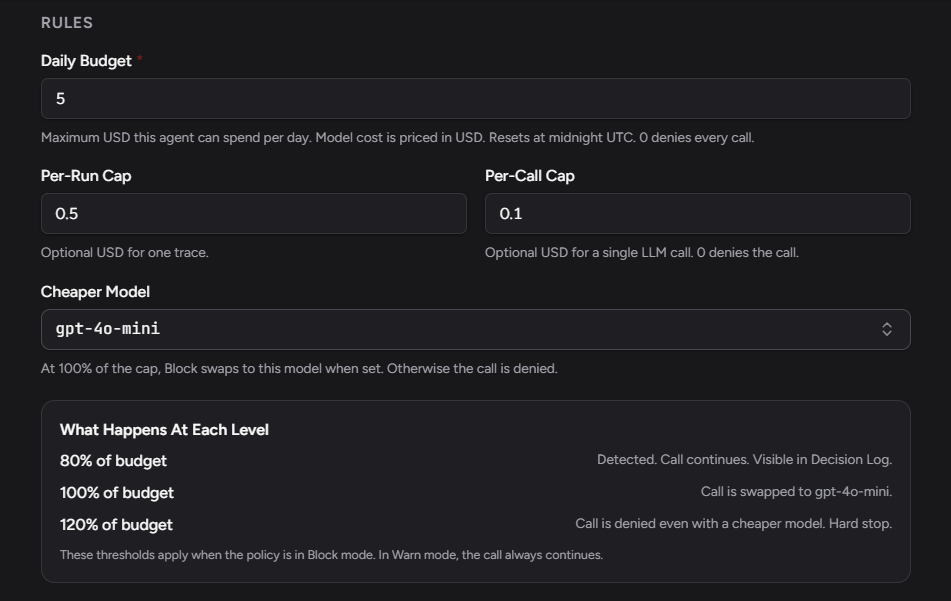
Figure 3. Centralized runtime policy definition in the Traccia UI. Engineering teams declare per-run and per-call boundaries, fallback models, and approval triggers visually in the dashboard—decoupling runtime policy enforcement from core agent application code.
from traccia import init, govern, observe, AgentBlockedErrorfrom traccia.governance import ApprovalPending, pending_tool_resultimport logging
logger = logging.getLogger(__name__)
# 1. Initialize agent identity and fail-closed posture for critical financial operationsinit(agent_id="support-refund-agent", policy_fail_mode="closed")
# 2. Instrument the tool. PEP checks pre-call policies (Spend Cap, Refund Guard)# Note: Traccia's Refund Guard defaults to inspecting 'amount' (configurable via Amount Field).@observe(name="process_refund", as_type="tool")def process_refund(order_id: str, amount: float, idempotency_key: str):    # This line is ONLY reached if pre-call policies allow the call:    return payment_gateway.refund(        order_id=order_id,        amount=amount,        idempotency_key=idempotency_key    )
# 3. Decorate the agent step with @govern to activate the Policy Enforcement Point (PEP)@govern(name="refund_desk")def handle_agent_refund_step(order_id: str, amount: float, idempotency_key: str):    try:        result = process_refund(            order_id=order_id,            amount=amount,            idempotency_key=idempotency_key        )        return {"status": "SUCCESS", "result": result}    except AgentBlockedError as err:        # Pre-call policy denied execution: the blocked request is not sent to the provider        logger.error(f"Policy denied execution before dispatch: {err}")        return {"status": "BLOCKED", "reason": str(err)}    except ApprovalPending as err:        # Held in Approvals inbox: return pending result so the model ends its turn cleanly        logger.info(f"Suspended for human sign-off: approval_id={err.approval_id}")        return pending_tool_result(err)
In Traccia's architecture, @govern activates the Policy Enforcement Point (PEP) across the agent workflow, while individual tools are instrumented with @observe(as_type="tool"). When process_refund is invoked under @govern, Traccia intercepts execution before the function body begins. If a hard budget or Refund Guard denies the operation, Traccia raises AgentBlockedError and execution halts immediately: the blocked request is never dispatched to the provider. When human approval is required, Traccia raises ApprovalPending; passing it to pending_tool_result(err) allows the agent model to conclude its turn cleanly without retrying while the action awaits review in the Approvals inbox.
Evaluating Agent Trajectories Beyond the Final Output
A common pitfall in agent engineering is evaluating an agent only by its final response string.
Suppose an agent generates a well-formatted refund confirmation. Behind the scenes, however:
- It retrieved customer data using an unindexed, slow database scan.
- It skipped the 30-day return policy verification step entirely.
- It thrashed tool invocations three times due to malformed JSON schemas.
- It exceeded expected token budgets by 400%.
Evaluating only the final output hides trajectory degradation. Production evaluation requires continuous measurement across execution efficiency, tool selection optimality, and policy adherence.
A Production Trajectory Evaluation Suite: 5-Dimensional Verification
To catch regressions before code reaches production, engineering teams must evaluate agent execution across five distinct dimensions: Correctness, Duplicate Actions, Recovery, Latency SLA, and Cost Budget.
import pytestfrom my_agent.refund_workflow import run_refund_agentfrom my_agent.mocks import MockPaymentGateway, NetworkDropFault
def test_refund_trajectory_reliability():    # Evaluates 5 critical production dimensions:    # 1. Correctness: Business calculation and order resolution    # 2. Duplicate Actions: Exactly one external payment mutation dispatched    # 3. Recovery: Safe resumption after mid-flight network crash    # 4. Latency SLA: Trajectory completes within 2,500ms    # 5. Cost Cap: Cumulative token spend strictly under USD 0.05    gateway = MockPaymentGateway()    # Simulate a mid-flight network drop on the initial payment dispatch attempt:    gateway.inject_fault_on_attempt(1, NetworkDropFault("504 Gateway Timeout"))
    # Execute workflow with durable ledger and Traccia OpenTelemetry tracing:    trajectory = run_refund_agent(        order_id="ord_48291",        issue_type="damaged_item",        amount=150.00,        gateway=gateway    )
    # 1. Correctness: Did the agent resolve the accurate business outcome?    assert trajectory.status == "COMPLETED"    assert trajectory.result["refund_amount"] == 150.00    assert trajectory.result["crm_status"] == "REFUNDED"
    # 2. Duplicate Actions: Did idempotency prevent double payment dispatch?    payment_spans = [s for s in trajectory.spans if s.name == "payment_gateway.refund"]    assert len(gateway.settled_transactions) == 1, "Duplicate payment settled!"    assert gateway.settled_transactions[0].idempotency_key == payment_spans[0].attributes["idempotency_key"]
    # 3. Recovery: Did the workflow heal the mid-flight crash without orphan state?    assert trajectory.ledger_entry.state == "COMPLETED"    assert trajectory.ledger_entry.crm_synced is True    assert trajectory.ledger_entry.retry_count >= 1
    # 4. Latency SLA: Did end-to-end execution stay within acceptable performance bounds?    assert trajectory.duration_ms < 2500, f"Latency SLA breached: {trajectory.duration_ms}ms"
    # 5. Cost Cap: Did total token consumption stay strictly within allocated FinOps budget?    assert trajectory.total_cost_usd <= 0.05, f"Cost exceeded limit: USD {trajectory.total_cost_usd:.4f}"
Running this suite in continuous integration guarantees that prompt edits, orchestrator upgrades, or tool refactors cannot silently re-introduce duplicate financial mutations, latency spikes, or cost blowouts into production.
Controlling What Autonomous Agents Spend
An autonomous agent can make dozens of LLM calls across subagent teams. As workflows grow in complexity, spend can escalate unpredictably.
The risk is amplified when an agent enters recursive reasoning loops or continuously retries failing tool calls. Monthly provider billing dashboards only surface this damage after the spend has occurred.
Traccia FinOps: Pre-Call Spend Cap and Loop Cap Enforcement
Traccia evaluates model calls before requests reach model providers using proactive token estimation heuristics. To reconcile real-world trade-offs between budget enforcement, prompt forecasting, and uptime, Traccia operates across four distinct governance dimensions:
- Forecasted Estimates vs. Settled Invoices: Pre-call checks multiply projected prompt tokens and max completion limits by provider list prices. Once the call returns, post-call spans record actual token usage and prompt caching discounts.
- Strict Block vs. Elastic Reshape Mode: Strict Block Mode halts calls at 100% of budget with
AgentBlockedError(the blocked request is not sent to the provider). Reshape Mode provides an elastic grace buffer, dynamically swapping to a cheaper model (e.g. GPT-4o → GPT-4o-mini) up to 120% of budget before hard termination. - Concurrent Budget Enforcement: Across distributed agent worker fleets, purely local in-memory counters suffer from race conditions where parallel workers simultaneously spend against a remaining quota. Traccia resolves this at the AI Gateway with centralized atomic token reservations; for ultra-high-throughput distributed workers, short-lived lease windows cap total theoretical concurrency overage to the active lease chunk size.
- Configurable Failure Posture: High-risk financial operations are configured with
policy_fail_mode="closed"(fail-closed), while conversational chat workflows can usepolicy_fail_mode="open"with high-priority telemetry alerts.
Explore our in-depth analysis on budgeting autonomous agents in AI Agent Cost Attribution and Rethinking FinOps for Autonomous AI Agents →
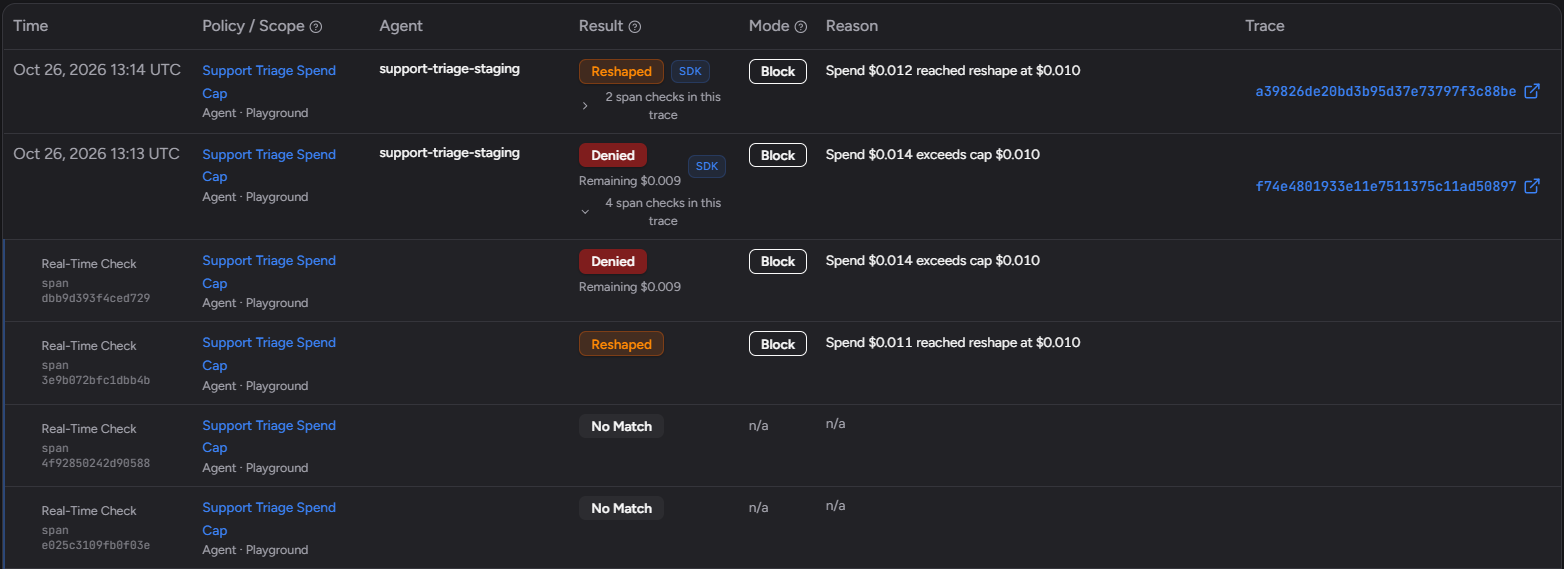
Figure 4. The Traccia Decision Log in Block mode. Each agent invocation is audited pre-flight: calls reaching the soft budget cap are automatically reshaped to the designated cheaper model, while requests exceeding hard limits are denied before incurring provider costs.
Production AI Agent Reference Architecture
Reliability in autonomous agent systems is not achieved by prompting alone. It requires a coordinated four-tier architecture:
@govern with @observe) governs tool executions (enforcing Loop Cap circuit breakers, high-risk parameter constraints like Refund Guard, and interactive approval gating).AFTER THE CALL · TELEMETRY and FINOPS RECOMPUTATION
Figure 5. Pre-execution runtime policy enforcement and spend governance flow: How runtime policies evaluate agent state and spend limits before external tools or models execute, followed by post-call telemetry attribution.
Reliability Is Built Around the Model
Connecting a large language model to external APIs is straightforward. Ensuring that system operates reliably in production across thousands of unpredictable user sessions is an engineering discipline.
Foundation models will continue to advance rapidly in reasoning, contextual comprehension, and tool usage. However, the operational realities of distributed software remain unchanged:
- Networks drop connections and latency spikes unpredictably.
- Concurrent subagents create race conditions across shared datastores.
- External APIs time out, return malformed payloads, or lack durable idempotency.
- Complex reasoning graphs drift into recursive loops and budget overflows.
The solution is not to wait for models that never make mistakes. The engineering solution is to design an architecture that remains resilient when failures inevitably happen.
Intelligence belongs to the model. Reliability belongs to the engineered system around it.
Frequently Asked Questions
How do I stop an AI agent from overspending on LLM calls?+
What happens when an AI agent hits its spend cap?+
AgentBlockedError, ensuring the blocked request is not sent to the provider. If a Cheaper Model fallback is configured, the call is reshaped and redirected to a lower-cost model up to 120% of the daily budget before shutting off.What happens to the agent if Traccia is unreachable?+
Can I enforce spend and policy boundaries without an SDK?+
@govern and @observe(as_type="tool")).Does a spend cap limit tokens or dollars?+
Does Spend Cap cover developer coding sessions like Claude Code or Cursor?+
References
External documentation, provider pricing, and API specifications verified as of October 2026. Telemetry and trace captures sourced from production Traccia agent environments.
- •Traccia docs
- •OpenTelemetry: Semantic conventions for generative AI systems
- •AWS Architecture: Making retries safe with idempotent APIs
- •Stripe: Idempotent Requests API Specification and Deduplication Contract
- •Temporal: Durable execution architectural patterns and workflow history
- •LangChain: LangGraph persistence and multi-agent state checkpoints
- •Visual Studio Code: Monitor agent usage with OpenTelemetry
- •Traccia: What is AI Agent Observability?
- •Traccia: Runtime Policy Enforcement for AI Agents
- •Traccia: AI Agent Cost Attribution
- •Traccia: AI Agent Evaluation Playbook
Build Reliable AI Agents with Traccia
Traccia is the complete runtime control plane and governance platform for autonomous AI agents. Combine pre-call policy enforcement (@govern), hard spend caps, loop breakers, and human approvals with OpenTelemetry-native distributed tracing to ship reliable agent systems at enterprise scale.